

How to Tell If Gold Is Real at Home: 5 Quick Tests
Table of Contents
- How to Tell If Gold Is Real at Home: 5 Reliable Tests
- How to Read Gold Jewelry Hallmarks
- How to Test Gold with Vinegar (and What It Can't Tell You)
- How to Tell Gold-Filled from Gold-Plated
- Why Weight and Heft Matter
- The Ceramic Scratch Test
- The Magnet Test, Explained
- Non-Destructive Testing for Vintage Jewelry
- Professional Gold Appraisal vs Home Testing
- Frequently Asked Questions
Last Updated: September 25, 2026
How to Tell If Gold Is Real at Home: 5 Reliable Tests
Learning how to tell if gold is real at home starts with one idea: real gold does not react to a magnet. This guide from Savannah Lane Jewelry walks through five tests you can run at your kitchen table.
Real gold is soft and dense: it will not stick to a magnet, feels heavier than it looks, and does not react to plain vinegar. One test means little alone; two or three agreeing results give you real confidence.
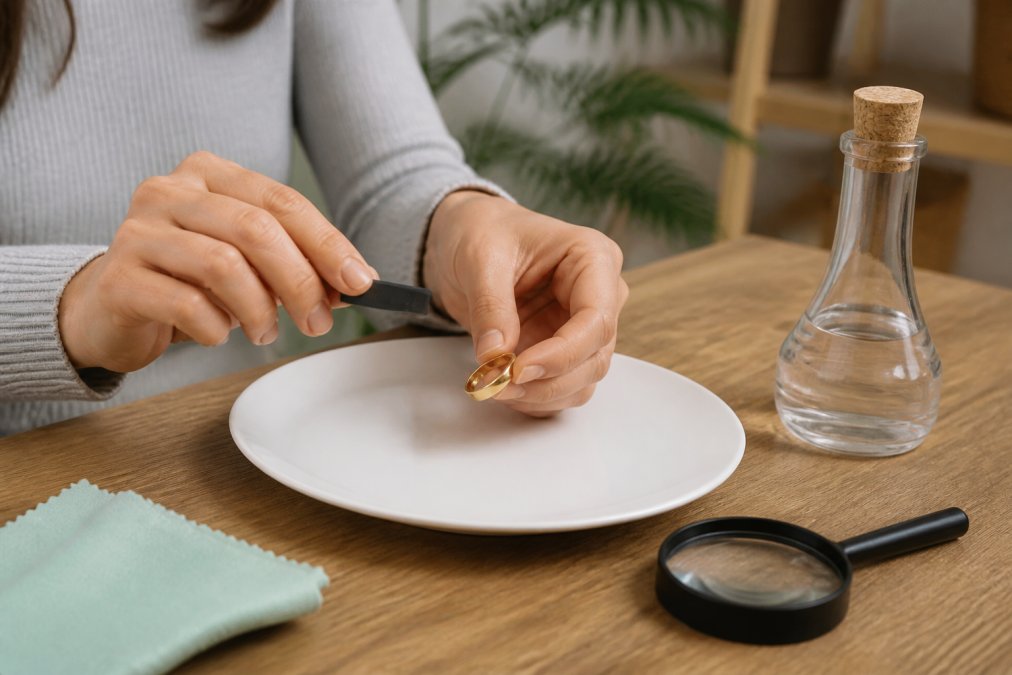
The five tests, ranked by how much they tell you: magnet, heft, ceramic scratch, vinegar, and hallmark inspection.
How to Read Gold Jewelry Hallmarks
A hallmark is the official stamp inside a piece stating its metal purity; on gold, look for a number followed by "K" or "kt," such as 10K, 14K, or 18K. The karat gives the gold-to-alloy ratio: 24K is pure gold, 14K is roughly 58% gold, and 10K is about 42% gold.
Check inside ring bands, on clasps, and on earring posts or backings. A stamp alone is not proof, counterfeiters stamp fakes all the time, but a missing or sloppy stamp is a warning sign. Our 10k Yellow Gold Endless Hoop Earrings are stamped 10k and described as solid gold, not plated.

How to Test Gold with Vinegar (and What It Can't Tell You)
Fill a small bowl with plain white vinegar, drop the piece in, wait 15 minutes, then rinse and dry. Real gold looks unchanged; if the metal darkens, turns green, or bubbles, it is likely base metal or plated.
Vinegar cannot confirm purity or catch good fakes, a thick gold-plated item passes easily.
How to Tell Gold-Filled from Gold-Plated
Gold-filled has a thick layer of gold bonded to a base metal, while gold-plated has a thin coating that wears off fast. The quickest way to tell them apart is the stamp: gold-filled is marked "GF" or "1/20 14K," gold-plated is marked "GP," "HGE," or "gold tone," and vermeil is marked "vermeil" or "sterling."
Gold-filled pieces hold up for years; gold-plated pieces often show wear within months at edges and high-contact points.
Why Weight and Heft Matter
Gold is dense, so a real gold ring feels noticeably heavier than a same-size fake, the free "heft" test. Compare two similar pieces side by side: the real one feels heavier and colder at first touch, since gold warms quickly in your hand.
This test is subjective, so treat it as supporting evidence and compare against a known real piece.
14K Yellow Gold Comfort Fit Wedding →
The Ceramic Scratch Test
An unglazed ceramic tile reveals a metal's true color: real gold leaves a gold streak, while fakes often leave a black or gray line. The unglazed ring on a ceramic mug's base works if you lack a tile.
Press lightly to avoid scratching the jewelry, and skip this test on vintage or fragile pieces since it can mark soft stones or plating.
The Magnet Test, Explained
Gold is non-ferrous, meaning it contains no iron, so a magnet will not pull real gold; most common fakes contain metals that a magnet does grab. Run a strong magnet slowly over the piece, if it sticks, the item is not solid gold.
One catch: some fakes use non-magnetic metals like copper or brass, so a pass is not proof.
Non-Destructive Testing for Vintage Jewelry
Old jewelry needs gentler handling, since plating wears thin and stones can be loose, so skip the scratch and acid tests entirely. Safe options: hallmark and stamp inspection with a magnifying glass, the magnet test, heft comparison against a known piece, and a digital scale to check gram weight.
Weigh the piece in grams and compare to the expected weight for its size and karat.
Professional Gold Appraisal vs Home Testing
Home tests tell you what a piece is not; a professional appraisal tells you what it is and what it is worth. A jeweler uses an assay, a touchstone with acid, or an electronic tester to confirm karat and purity precisely, and an appraisal documents value for insurance or resale.
| Method | What It Confirms | Best For | Cost |
|---|---|---|---|
| Home tests | Rough authenticity | Quick screening | Free |
| Jeweler's test | Exact karat | Buying or selling | Low |
| Full appraisal | Value and purity | Insurance, resale | Higher |
Frequently Asked Questions
How to check gold instantly?
The fastest check is to look for a hallmark stamp like '14K' or '10K' inside the band. If you have a magnet, see if the piece sticks; real gold is non-ferrous and won't be attracted. A quick vinegar drop on a scratch can also show a reaction if the metal is not solid gold. These take seconds but aren't definitive.
Can vinegar test gold?
Vinegar can indicate if a piece is definitely not gold, but it cannot confirm real gold. Real gold resists vinegar, so no color change is a good sign. However, gold-plated or gold-filled items may also resist vinegar if the coating is thick. For a reliable answer, use professional appraisal or an acid test kit.
What is the best way to test gold at home?
Start with a visual inspection for hallmarks and use a magnet. If the piece is non-magnetic and stamped, try the vinegar test on a small scratch. For higher confidence, use a digital scale to check specific gravity against known gold densities. No home test is 100% accurate, so a jeweler's appraisal is best for valuable items.