

Why Gold Jewelry Is Better for Sensitive Skin
Table of Contents
- Why Gold Jewelry Is Better for Sensitive Skin
- What Makes Gold Jewelry a Smart Choice for Sensitive Skin
- Gold Allergy Symptoms and How They Differ From Irritation
- Best Metals for Sensitive Skin Beyond Gold
- 14k vs. 18k Gold for Sensitive Skin: Which Purity Works Best
- Is Gold-Plated Jewelry Safe for Sensitive Skin?
- How to Choose and Care for Gold Jewelry for Sensitive Skin
- Conclusion
- Frequently Asked Questions
Last Updated: October 16, 2026
Why Gold Jewelry Is Better for Sensitive Skin
Gold jewelry is better for sensitive skin because pure gold is one of the least reactive metals on earth. It resists corrosion, holds its shine, and rarely triggers the red, itchy reactions that cheaper metals cause. That single fact explains why so many dermatologists point sensitive-skin shoppers toward gold first.
Reactions to jewelry are common. The American Academy of Dermatology notes that nickel is the most frequent cause of allergic contact dermatitis from jewelry, and nickel hides inside many base-metal pieces. Gold sidesteps that problem almost entirely.
Below, we explain what makes gold different, how to spot a real allergy, and how to pick pieces that treat your skin gently.
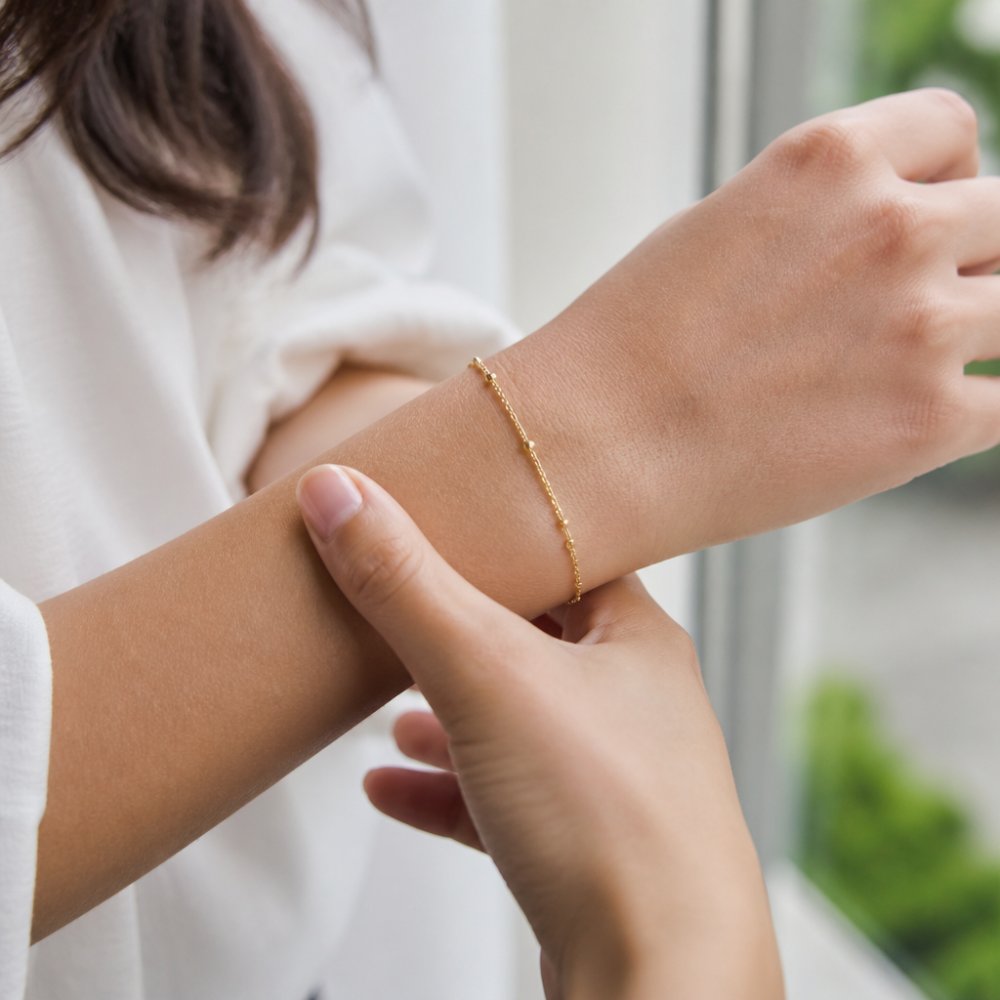
What Makes Gold Jewelry a Smart Choice for Sensitive Skin
Hypoallergenic jewelry is jewelry made from metals that rarely trigger an immune response. Gold earns that label because the metal itself is inert. It does not corrode, tarnish, or shed reactive particles onto your skin the way base metals do.
Here is what sets gold apart:
- It resists corrosion. Sweat, lotion, and humidity do not break gold down.
- It forms no irritating oxides. Base metals oxidize and leave residue on skin.
- It stays stable over time. The surface you wear today looks like the surface you bought.
- It holds up to daily wear. Gold handles showers, workouts, and long office days.
One caveat matters. Pure gold is soft, so jewelers mix it with other metals to make it durable. That mix is called an alloy, and the alloy metals are where sensitivity can sneak in.
Gold Allergy Symptoms and How They Differ From Irritation
True allergy to gold itself is uncommon, but reactions to jewelry are not. The three conditions below look similar in a photo and behave very differently on your skin. Telling them apart is the difference between switching metals and needing a doctor.
Allergic contact dermatitis (ACD) is a delayed immune response. It does not appear the first time you wear a metal. Your immune system has to be sensitized first, which can take repeated exposures over weeks, months, or years. Once sensitized, the reaction follows a predictable pattern:
- Timing: symptoms appear 12 to 72 hours after contact, not immediately.
- Location: a sharp-edged rash confined to where metal touches skin, sometimes with streaking where a chain or clasp rested.
- Appearance: itching first, then redness, then tiny blisters or vesicles that may weep and crust.
- Resolution: the rash can take one to three weeks to clear after you stop wearing the piece, and it often itches after the visible rash fades.
Irritation (irritant contact dermatitis) is not an immune response. It is physical or chemical damage to the skin surface.
- Timing: appears within hours of wear, sometimes within minutes.
- Location: exactly where the piece rubs or traps moisture.
- Appearance: redness, chafing, dryness, and a burning or stinging sensation rather than intense itch.
- Resolution: fades within a day or two once the piece is removed and the area is cleaned and dried.
Infection is the one that needs medical attention. It is most common in new or poorly healed piercings, where bacteria enter the tract.
- Timing: develops over days and worsens rather than plateauing.
- Signs: warmth to the touch, swelling that spreads past the jewelry, throbbing pain, pus that is yellow or green, and sometimes fever.
- Resolution: does not improve on its own and can worsen quickly. Remove the jewelry only if a clinician tells you to, since removing it from a closed piercing can trap infection.
A simple way to separate them:
| Clue | Allergy (ACD) | Irritation | Infection |
|---|---|---|---|
| Onset | 12-72 hours | Minutes to hours | Days, worsening |
| Main symptom | Intense itch | Burning, chafing | Pain, heat |
| Rash edge | Confined to contact area | Confined to friction area | Spreading |
| After removing jewelry | Improves slowly over weeks | Improves within 1-2 days | Keeps worsening |
When to stop wearing jewelry and seek care. Stop wearing the piece immediately if you see blistering, weeping, or a rash that spreads beyond the contact area.
Why piercings behave differently. A healing piercing is an open wound, so it is more vulnerable to both irritation and infection than intact skin. The tract also holds moisture and debris against the metal, and friction from sleeping on the jewelry is a frequent trigger.
The most common misattribution. People often blame gold when the real culprit is the alloy underneath. If a reaction appears under a low-cost "gold" ring, the piece is likely plated brass or copper, and the gold layer has worn through.
Best Metals for Sensitive Skin Beyond Gold
Gold is not your only option. Several metals work well for reactive skin, and each has trade-offs.
| Metal | Sensitivity Risk | Best For | Notes |
|---|---|---|---|
| 14k-18k gold | Low | Everyday wear | Durable, tarnish-resistant |
| Platinum | Very low | Heirloom pieces | Heavy, costs more |
| Titanium | Very low | Piercings | Lightweight, strong |
| Sterling silver | Low | Budget-friendly | May tarnish over time |
| Stainless steel | Low | Casual wear | Can contain trace nickel |
| Gold-plated | Medium to high | Short-term wear | Wears through with use |
For most people with sensitive skin, solid gold and platinum are the safest picks. Titanium is a strong choice for new piercings because it is lightweight and inert.
Silver deserves a mention. Quality sterling silver is usually fine for sensitive skin, though it tarnishes and needs occasional polishing.
14k vs. 18k Gold for Sensitive Skin: Which Purity Works Best
14k gold is the better pick for most sensitive-skin shoppers. It blends 58.3% pure gold with alloy metals, which makes it strong enough for daily wear. The higher gold content still keeps reactivity low.

18k gold contains 75% pure gold, so it is softer and richer in color. It suits people who want maximum gold content and do not mind a gentler metal.
24k gold is nearly pure. It is beautiful but too soft for most rings and clasps.
14k Yellow Gold Cubic Zirconia Stud Earrings, 2mm →
Here is the trade-off in plain terms:
- 14k: tougher, lower cost, great for rings and bracelets
- 18k: more gold, deeper color, better for earrings and necklaces
- 24k: purest, softest, best saved for special pieces
The higher the karat, the more gold and the less alloy. That is why higher-karat pieces tend to be gentler on reactive skin.
Is Gold-Plated Jewelry Safe for Sensitive Skin?
Gold-plated jewelry is usually not the best choice for sensitive skin, but the reason is more specific than most articles admit. The problem is not the gold.
How the layers actually work. Plated, filled, and vermeil jewelry all put gold over a different core metal. What separates them is the thickness of that gold layer and how it is bonded.
| Finish | Gold layer | Core metal | How it wears |
|---|---|---|---|
| Gold-plated | Very thin, often under 0.5 microns | Brass, copper, or nickel alloy | Wears through in weeks to months with daily wear |
| Gold-filled | Much thicker, bonded under heat and pressure | Brass or copper | Lasts years; can still expose core at edges |
| Gold vermeil | Thicker gold over sterling silver | Sterling silver | Durable, but silver core can tarnish |
| Solid gold | Entire piece is gold alloy | None | Does not wear through to a different metal |
A micron is one-thousandth of a millimeter. A typical gold-plated layer is a fraction of that, which is why it disappears so quickly on rings, clasps, and earring posts, the spots that see the most friction and moisture.
Where plating fails first. Watch the highest-contact points: the inside of a ring band, the hinge of an earring back, the clasp of a chain, and any edge where the piece was cut or soldered.
Gold-filled and vermeil are better, not equal. Gold-filled jewelry bonds a much thicker gold layer to the core, so it resists wear far longer than plating.
How to verify a nickel-free claim. "Nickel-free" and "hypoallergenic" are marketing terms, not regulated standards, so they mean whatever the seller decides they mean. To get real information:
- Ask for the alloy composition in writing. A fine-jewelry seller can tell you the exact metals mixed with the gold, not just the karat. A vague answer is a signal.
- Look for a karat stamp. "14K" or "18K" means the piece is a solid gold alloy. "GP" means gold-plated, "GF" means gold-filled, and "HGE" means heavy gold electroplate.
- Read the product description for the core metal. If it does not name the base metal, ask. Brass and copper are common and generally low-reactivity; nickel-containing alloys are the ones to avoid.
- Treat "hypoallergenic" as a starting point, not a guarantee. Reactions vary by person, and even a well-made alloy can bother someone with a specific sensitization.
The practical takeaway. If your skin has reacted before, skip plated pieces for anything you wear daily, especially rings and earrings that sit against skin for hours. Gold-filled and vermeil are reasonable middle options for occasional wear.
How to Choose and Care for Gold Jewelry for Sensitive Skin
Choosing well comes down to a few habits.
- Look for a karat stamp. "14K" or "18K" means solid gold. "GP" means gold-plated.
- Ask about alloy metals. Nickel-free pieces are safest for reactive skin.
- Start with earrings and rings. These sit against skin longest.
- Patch test new pieces. Wear for a few hours before all-day use.
- Clean regularly. Wipe with a soft cloth to remove lotion and oils.
- Store dry. Keep pieces away from perfume and humidity.
Care habits matter as much as metal choice. Rinse and dry jewelry after workouts. Skip lotions and perfumes near the metal, since buildup can trap irritants against skin.
Our 14k gold pieces, like the 14k Yellow Gold Cubic Zirconia Stud Earrings, are made from solid gold rather than plated metal. That matters for anyone who has reacted to jewelry before.
Conclusion
Sensitive skin does not have to mean giving up jewelry you love. The fix is simpler than most people expect: choose solid gold over plated metal, check the karat, and care for your pieces well.
At Savannah Lane Jewelry, we craft fine gold and sterling silver pieces made for everyday wear, with free shipping on every order. Sign up for our email list and get 10% off your first purchase.
Frequently Asked Questions
Can you develop a gold allergy later in life?
Yes, a metal allergy can appear at any age, even if you have worn gold jewelry for years without issue. Reactions are usually triggered by alloy metals like nickel or cobalt rather than pure gold itself. If you notice new redness, itching, or a rash where your jewelry sits, stop wearing the piece and see a dermatologist for patch testing to identify the exact trigger.
Is gold jewelry hypoallergenic?
Pure gold is generally considered hypoallergenic, but most jewelry gold is alloyed with other metals. The higher the karat, the lower the percentage of alloy metals, which reduces irritation risk. Solid 14k and 18k gold are common choices for sensitive skin because they contain less nickel and other reactive metals than lower-karat or plated pieces. Always check the metal composition before buying.
Which gold purity is best for sensitive skin?
For most people with sensitive skin, 14k or 18k gold offers a good balance of durability and low reactivity. Higher-karat gold like 18k contains more pure gold and fewer alloy metals, which can mean less irritation. However, 14k is harder and more resistant to wear, making it a practical choice for everyday pieces like stud earrings or hoops.
Can gold-plated jewelry irritate sensitive skin?
Yes, gold-plated jewelry can irritate sensitive skin because the base metal underneath may contain nickel or other allergens. Once the thin gold layer wears away, the base metal touches your skin directly, increasing reaction risk. If you have known metal sensitivities, solid gold or gold-filled pieces are safer options because the gold layer is thicker or the piece is solid throughout.
If your skin has reacted to jewelry before, you deserve pieces that treat it kindly. Savannah Lane Jewelry offers solid gold and sterling silver designs built for daily wear, backed by free shipping and a curated selection of timeless styles. Get started with Savannah Lane Jewelry and find gold pieces your skin will thank you for.